

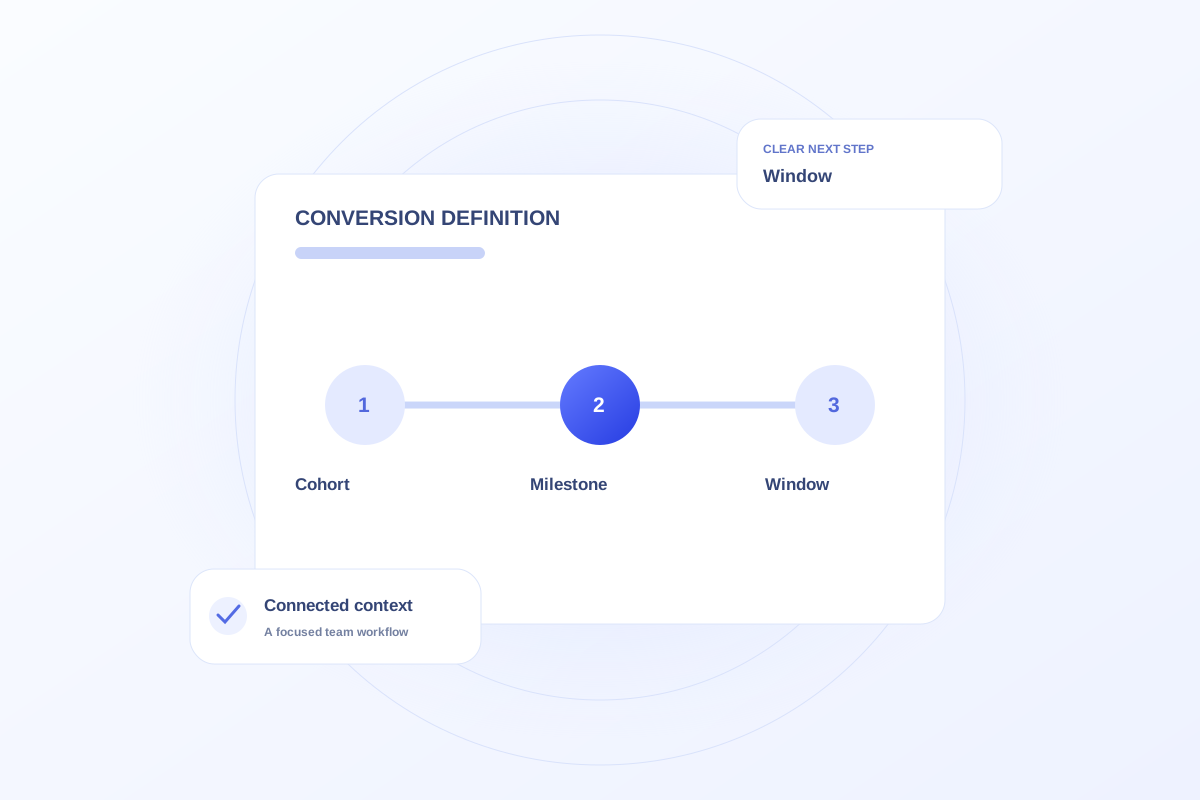
Define an inquiry-to-evaluation conversion rate as the share of an explicitly defined inquiry group that reaches a specified evaluation milestone during an observation window. State whether the milestone is booked or completed. Do not divide unrelated monthly totals and assume they describe the same patient cohort.
Choose the population and milestone
Specify which inquiries are included, such as new direct-patient inquiries created during a defined period. Then specify whether the outcome is a booked evaluation or a completed evaluation. Keep provider referrals separate when the reporting question requires it.
For a fictional cohort of 40 eligible inquiries, 10 reaching the defined milestone would equal 25 percent. This is an arithmetic example, not an Ovrflo result or an industry benchmark.
Give the cohort time to progress
State the observation window and how unfinished journeys are handled. Inquiries received near the end of a period may not have had the same opportunity to reach an appointment as those received earlier.
Explain exclusions and record corrections. A rate is difficult to compare over time if the practice changes eligibility rules without documenting the change.
Validate the underlying records
Ovrflo’s illustrative reporting and linked patient workflows can help a team discuss the definitions it needs. Review a sample booking and source record rather than relying on a chart label alone.
Before using a production rate, confirm duplicate handling, milestone dates, and source matching. Demo values are fictional and should not be used as evidence of performance or a target for a practice.
Your working checklist
- Define the inquiry cohort.
- Choose booked or completed evaluation explicitly.
- State the observation window and exclusions.
- Validate duplicates, sources, and milestone dates.
See the workflow in Ovrflo.
Explore the related workspace with fictional data, then discuss what your team would need in practice.