

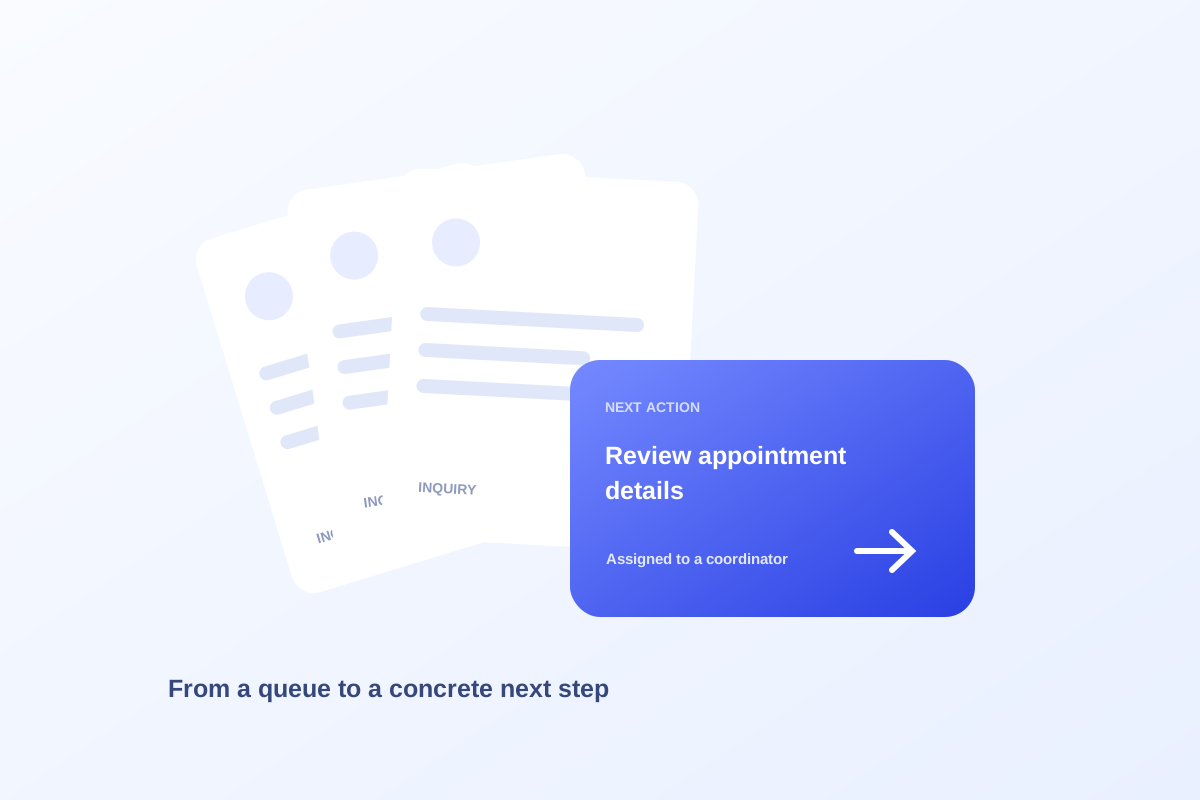
Review a patient inquiry queue for records without a clear owner, an understandable current stage, or a concrete next action. Check whether appointment information changes the administrative follow-up needed. A queue helps organize work; the practice’s clinical and patient-contact procedures determine appropriate priority and communication.
Look for missing information that blocks action
An inquiry can be visible in the queue while still lacking the context needed to proceed. Identify whether the source, stage, appointment status, or responsible person needs verification. Keep unknown details explicit rather than filling them in from an assumption.
If the record raises a clinical question, use the appropriate escalation process. A marketing or administrative queue should not be used to infer clinical urgency.
Distinguish waiting from abandoned work
A record waiting for a future appointment is different from one waiting for an unassigned call. State what the inquiry is waiting for and who owns the next administrative step. A due date is useful only when it belongs to a clear action.
For a fictional inquiry with a booked evaluation, check the linked appointment before assigning another booking task. Keep repeated interactions connected to the existing journey so the queue does not grow simply because the patient contacted the practice again.
Review exceptions with the team
In Ovrflo’s Patient Intake demo, open a fictional inquiry and its linked booking context. Ask whether another coordinator could understand the next action without reconstructing the history.
Use the team review to resolve unclear ownership and confirm the next step. The demo does not send messages, receive live forms, or verify appointment status against an EHR; production queue rules and data sources need separate confirmation.
Your working checklist
- Identify records missing an owner or next action.
- Verify unclear stages and appointment details.
- Separate scheduled waiting from blocked work.
- Use approved escalation and patient-contact procedures.
See the workflow in Ovrflo.
Explore the related workspace with fictional data, then discuss what your team would need in practice.