

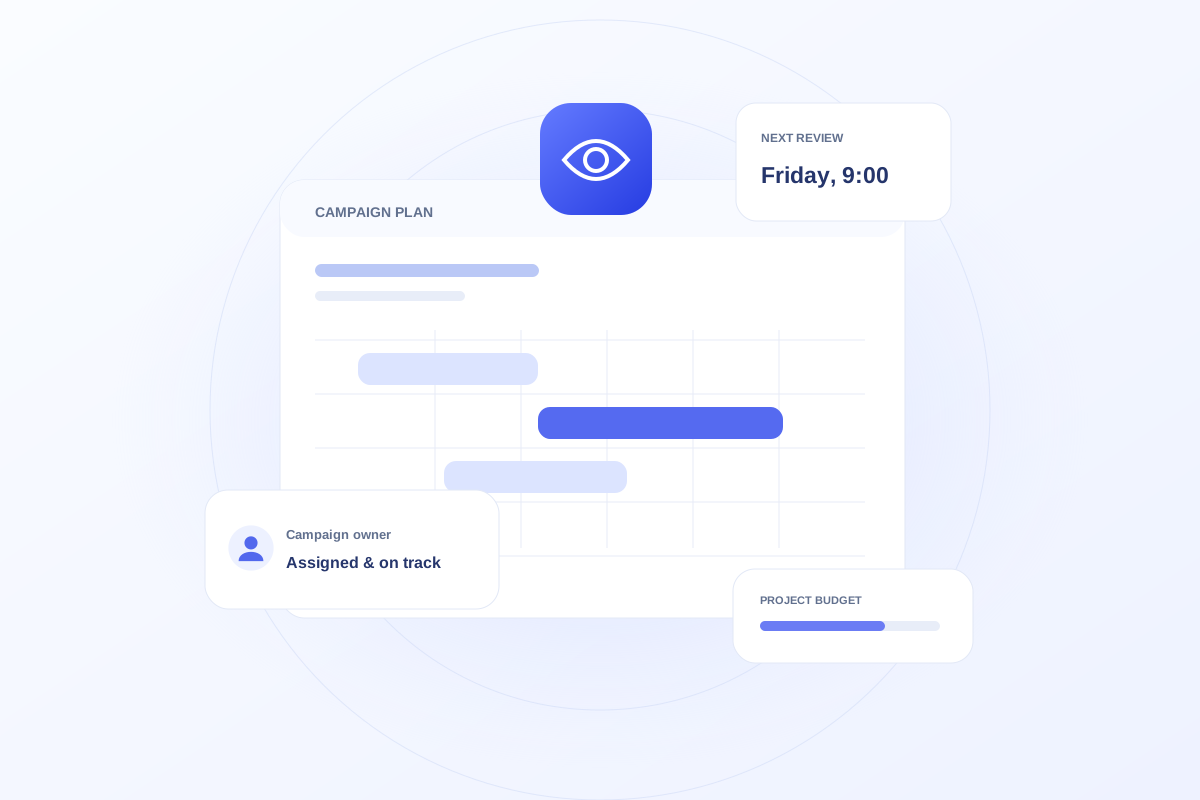
A useful marketing operations plan records what the team will do, who owns each commitment, when it is due, which vendors support it, and how progress will be reviewed. Keep the work plan connected to spending and reporting, rather than treating a performance chart as the whole plan.
Start with a weekly work review
List the campaigns, events, website updates, and vendor decisions the team is actively handling. For each item, record one owner and the next concrete action. “Review landing page copy by Friday” gives a teammate a clearer handoff than “website campaign.”
At the weekly review, ask what finished, what is blocked, and which decisions need attention. Move unfinished work deliberately. A due date should reflect an agreed next step, not an automatic rollover that hides the delay.
Connect the vendor to the commitment
For each vendor, record the service, internal owner, related project, and the dates your team needs to review. Keep renewal and cancellation deadlines distinct from invoice dates. They answer different questions.
A useful example is an event project with a venue, a design vendor, and a print deadline. The project groups the work; the vendor record holds the relationship; the task names the next action. Use fictional information when exploring this example in the demo.
Define what a report actually measures
Agree on what counts as an inquiry, a booked evaluation, and a completed evaluation before comparing channels. A booked appointment and an attended appointment are different milestones. Keep the original acquisition source available as the patient progresses.
Review activity alongside outcomes. A completed task shows work was done; it does not prove that the task caused a booking. Explain gaps in the data before drawing a conclusion about a vendor or channel.
Your working checklist
- Every active initiative has an owner and next action.
- Vendor review and renewal dates are recorded.
- Expenses have a clear project or vendor context.
- Reporting definitions distinguish inquiries, bookings, and attendance.
See the workflow in Ovrflo.
Explore the related workspace with fictional data, then discuss what your team would need in practice.