

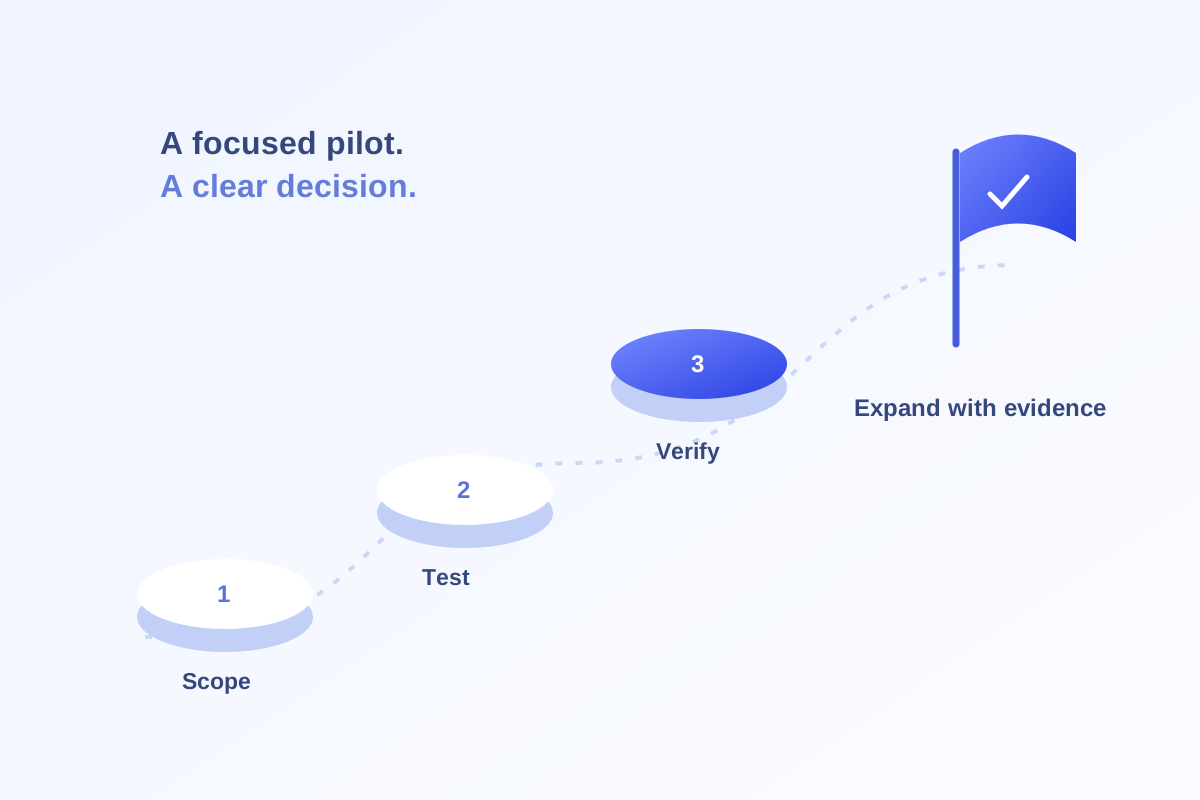
Define pilot success with a bounded workflow, named participants, observable acceptance criteria, and a review date. Test whether the team can complete the intended work and handle exceptions. Keep workflow evidence separate from claims about revenue, growth, or clinical outcomes that the pilot has not established.
Choose a scope the team can evaluate
Select a specific job, such as coordinating marketing assignments or preparing liaison visits. Describe who performs it and what a completed workflow looks like. Avoid making the pilot responsible for every operational issue the practice wants to solve.
A fictional acceptance criterion might require a team member to find the owner and next action for each sampled assignment. That tests an observable workflow rather than a broad promise to “improve efficiency.”
Test exceptions as well as the normal path
Include missing information, an unavailable owner, a changed deadline, and a correction to a record. Decide how the team will document these cases and who can resolve them. A smooth prepared demonstration may not reveal the work required when a handoff fails.
Review any integration, access, security, and data-source requirements before real use. A successful workflow exercise does not establish production readiness in those areas.
Make the expansion decision from evidence
Use Ovrflo’s public demo to identify scenarios and questions for a proposed pilot. Record which behavior is demonstrated and which production requirements remain to be verified.
The demo is not itself a shared production pilot. It uses fictional browser-local records. Before expanding a real deployment, compare the evidence with the agreed acceptance criteria and confirm the scope, support, and unresolved requirements with the responsible team.
Your working checklist
- Define a bounded workflow and participants.
- Write observable acceptance criteria.
- Test corrections and failed handoffs.
- Review evidence before expanding scope.
See the workflow in Ovrflo.
Explore the related workspace with fictional data, then discuss what your team would need in practice.