

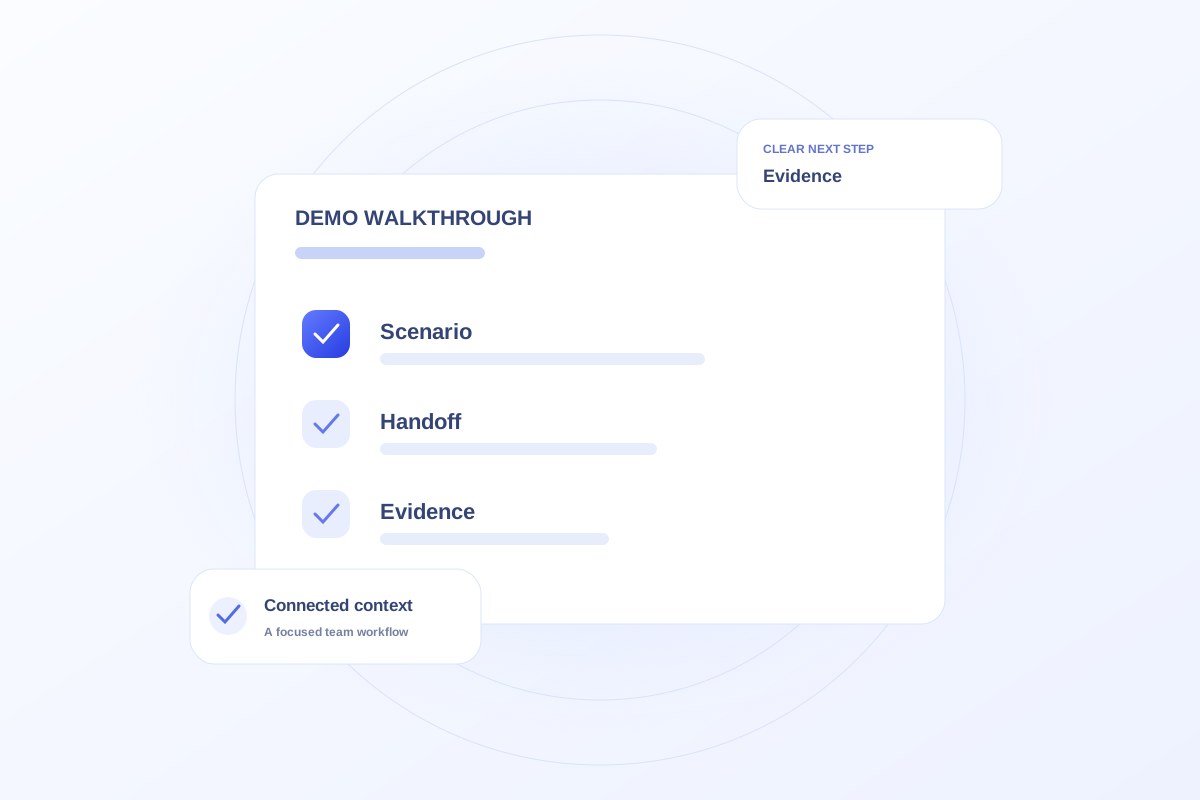
Test an operations demo with a small set of representative tasks: prepare a liaison visit, assign marketing work, review a booking, and identify a reporting question. Ask each role to complete its own workflow. Keep demonstrated functionality separate from proposed integrations and production commitments.
Choose scenarios before the walkthrough
Bring examples of work the team struggles to coordinate, expressed without real patient information. Define what a successful walkthrough would show, such as finding an owner, changing a next action, or opening related context.
Avoid testing every visible control without a purpose. A scenario makes it easier to judge whether a product helps the actual handoff your team needs.
Test the path between teams
Ask what happens when work moves from a liaison to a coordinator or from a marketing project to a vendor review. Check whether the receiving person can understand the next action.
Review reports after making a fictional change, and ask which source and period the report uses. A polished chart is not enough to establish that the underlying definitions fit the practice.
Document what remains to be verified
Ovrflo’s demo can support a focused evaluation of its separate workspaces and linked records. Record questions about real users, permissions, data feeds, migration, and integrations for a follow-up discussion.
The public demo is browser-local with fictional data. It does not prove production security readiness, shared storage, EHR synchronization, or live analytics. Evaluate those requirements explicitly.
Your working checklist
- Choose role-specific scenarios.
- Use fictional information throughout the public demo.
- Test handoffs and reporting definitions.
- List production requirements that remain unverified.
See the workflow in Ovrflo.
Explore the related workspace with fictional data, then discuss what your team would need in practice.